
Sant Narcís fairs: Girona's Biggest Festival and What the City Eats
Discover why the Fires de Sant Narcís are one of the best times to visit Girona, from the legend behind the festival to the street food, the traditions and the autumn table.
October is one of the most interesting months to be in Girona. The summer visitors have gone, the weather is still mild, and at the end of the month the city gives itself over to the Fires de Sant Narcís, the festa major or main annual festival of Girona. In 2026 the festival runs from 23 October to 1 November.
The Fires are held in honor of the city's patron saint, whose feast day falls on 29 October. They are not a heritage display arranged for visitors. They are what Girona does each year for itself, across ten days and two weekends, and the food that appears in the streets during those days is as much a part of the tradition as the music and the parades.
The Saint, the flies and the city
Sant Narcís was, according to tradition, a bishop of Girona martyred in the city in the early fourth century, and his remains have been kept at the church of Sant Feliu ever since. His cult grew from the eleventh century onwards, and by the Middle Ages he had become the patron saint of Girona. His feast day, October 29, is still an official public holiday in the city.
The legend that fixed him in local memory dates from 1285, when French troops besieged Girona and broke open his tomb at Sant Feliu. A swarm of flies is said to have come out and driven them off. The fly has been associated with the city ever since, and the saying still circulates: per Sant Narcís, cada mosca val por six, around Sant Narcís, every fly is worth six.
From Medieval Trade Fair to City Festival
The word fires means fairs, and that is what the celebration began as. Girona held several fairs throughout the year, each tied to a different feast day, and over time they merged into the single one that fell around the procession of Sant Narcís. It drew traders, farmers and livestock into the city from across the region.
The commercial side still exists, now housed at the Palau de Fires on the edge of the Devesa, where the Fira de Mostres runs from 29 October to 1 November and reaches its sixty-fourth edition this year. The festival itself long ago outgrew that origin. The funfair fills the Devesa, and the barraques, the bars run by local associations, nineteen of them this year, occupy the Copa esplanade. Concerts move between neighborhoods, and the old town fills with markets and street events.
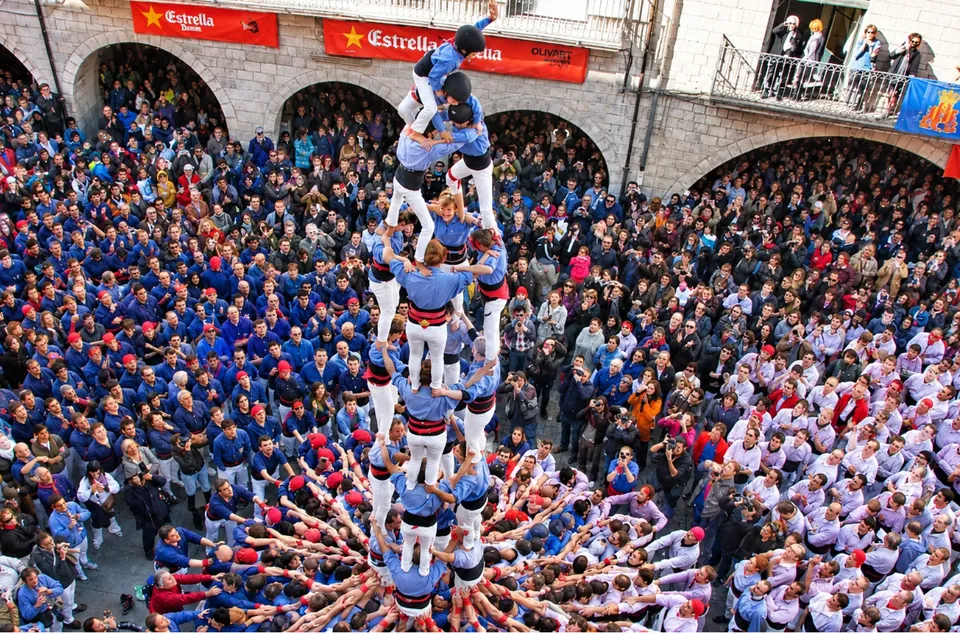
The traditional side has fixed dates, and it is the part worth planning an evening around. The giants and capgrossos set out through the streets at six on the evening of 23 October, followed by the dances in Plaça del Vi that opened the festival. The correfoc runs late on 24 October, when the Diables de l'Onyar take drums and fireworks through the Barri Vell, and the Diada Castellera fills Plaça del Vi on the morning of 25 October.
The last weekend brings the rest. A pillar is carried up the cathedral steps on the evening of 31 October, and the giants and bestiary gather one final time in the Parc del Migdia on the morning of 1 November. On Sant Narcís itself, 29 October, the sardanes are danced in Plaça del Vi in the late afternoon. Walking the old town with a local guide is particularly rewarding on these nights, when the streets are at their busiest.
What Girona Eats During the Fires
Festival food here is deliberately old-fashioned. Chestnuts and sweet potatoes roast over coals and are sold in paper cones, churros are thick and ridged and meant for dipping, toffee apples and candy floss fill the stalls around the funfair, and grilled sausage in bread is the standard supper of anyone spending the evening at the barraques.
The food fair, the Fira-Mercat d'Alimentació Artesana, sets up in Plaça de la Independència for the full run of the festival, from 23 October to 1 November, with cheeses, cured meats, anchovies, honey and nougat. The selling technique has not changed in decades: a slice of something is laid on a piece of bread with tomato and offered with a cheerful try it.
At home the menu is a different one. The food writer Salvador Garcia-Arbós, who devoted two volumes to the subject in Girona. Menjars de Fires, draws the line clearly. The street belongs to sausage and beer at the barracks, while the family table during these days means cannelloni, roast meat, panellets and chuixos. The xuixo is Girona's own contribution: a fried, sugar-crusted cylinder filled with crema catalana, invented in this city and best eaten warm and early in the day, which is roughly where a morning market food tour begins.
The Chestnut at the End of the Week
The Fires run into Tots Sants, All Saints, on 1 November, so the final weekend of the festival doubles as the Castanyada. Chestnuts and sweet potatoes appear again, this time at the table rather than on the street.
The sweet that defines the date is the panellet: a small marzipan confection, most often rolled in pine nuts but also made with coconut, almond or coffee, and traditionally served with a glass of sweet moscatel. Bakeries produce them for a few weeks a year and no longer, and every family in the city has firm views on which shop does them properly.
Visiting Girona During the Fires
A few practical points are worth knowing in advance. The 29th of October is a local public holiday, so some shops close and others keep shorter hours. Restaurants fill quickly over the weekend of 31 October and 1 November, and reservations are advisable.
The evenings are the best part of the festival. The old town is lit, the squares stay busy late, and the autumn weather in Girona is mild, comfortable afternoons, cool nights and a fraction of the crowds of July. The whole thing closes with the castell de focs, the fireworks display, at eight on the evening of 1 November in the Parc de les Ribes del Ter.
Final Thoughts
Girona is a small city with a long memory, and the Fires are the clearest expression of it. For ten days the streets belong to the people who live in them, the food is what this city has always eaten at this time of year, and the whole thing takes place whether or not anyone comes to watch.
That is what makes it worth traveling for. The festival lasts ten days. The story behind it has lasted more than seven centuries.